

Dual Wavelength 980nm 1470nm Diode Laser Lipolysis Machine For Body Fat Reduction And Skin Tightening
Dual Wavelength 980nm 1470nm Diode Laser Lipolysis Machine For Body Fat Reduction And Skin Tightening
High-power lipolysis laser,Dual-wavelength lipolysis device,Minimally-invasive fat reduction,Non-surgical fat melting,Targeted adipose emulsification,980nm laser lipolysis,1470nm fat reduction,Fiber-optic lipolysis handpiece,Clinical lipolysis treatment,Office-based lipolysis machine
What is Lipolysis?
Lipolysis is a minimally invasive laser-assisted procedure that uses targeted laser energy to thermally disrupt and emulsify subcutaneous fat cells, coagulate small blood vessels, and stimulate skin tightening and collagen remodeling. The procedure delivers laser energy beneath the skin through a thin fiber to achieve localized adipose melting with reduced bleeding and accelerated tissue contraction compared with traditional mechanical liposuction.
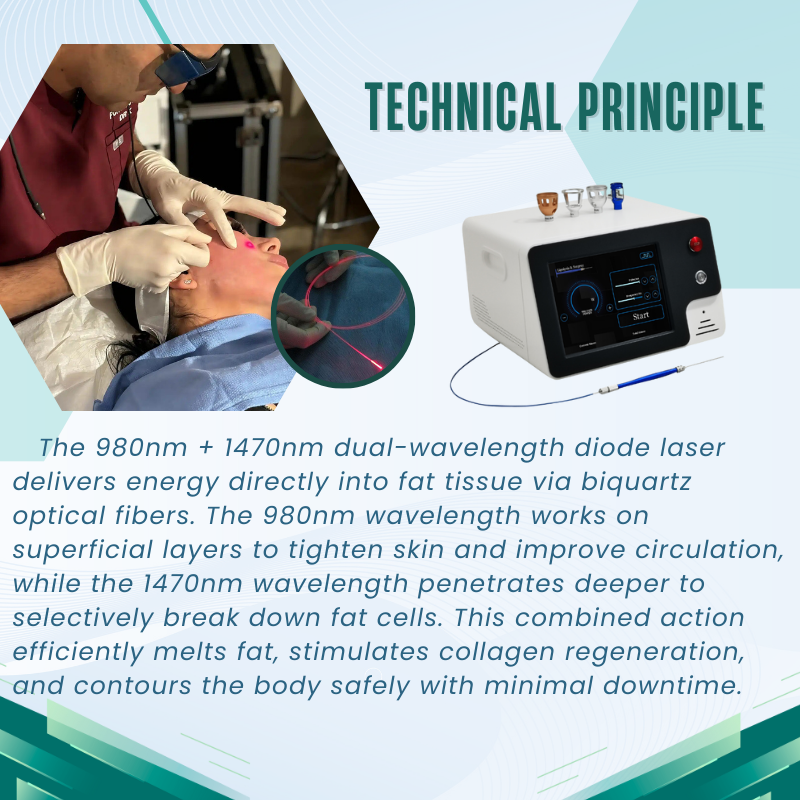
1. Technical principle
Dual-wavelength synergy: this system combines a 980 nm diode and a 1470 nm diode. In practical use the two wavelengths act synergistically — the 980 nm component contributes efficient tissue ablation and haemostatic effect, while the 1470 nm component is strongly absorbed by water and demonstrates effective heating of subcutaneous tissue that helps collagen contraction and skin tightening. Together they liquefy adipocytes, seal small vessels, and promote dermal remodeling.
Fiber delivery: energy is delivered through a biquartz optical fiber inserted through a small entry point. The fiber tip converts light energy into localized heat in the fat layer, producing adipocyte membrane disruption and liquefaction that can be aspirated or allowed to resorb depending on the technique.
Modes of operation: the device supports CW (continuous), pulse and single modes with adjustable pulse width and duration — this allows clinicians to fine-tune thermal dose for different treatment zones and tissue thicknesses.
2. Application range
Appropriate clinical uses for the lipolysis function include:
Small- to medium-volume body contouring: abdomen, flanks, inner/outer thighs, upper arms, hips.
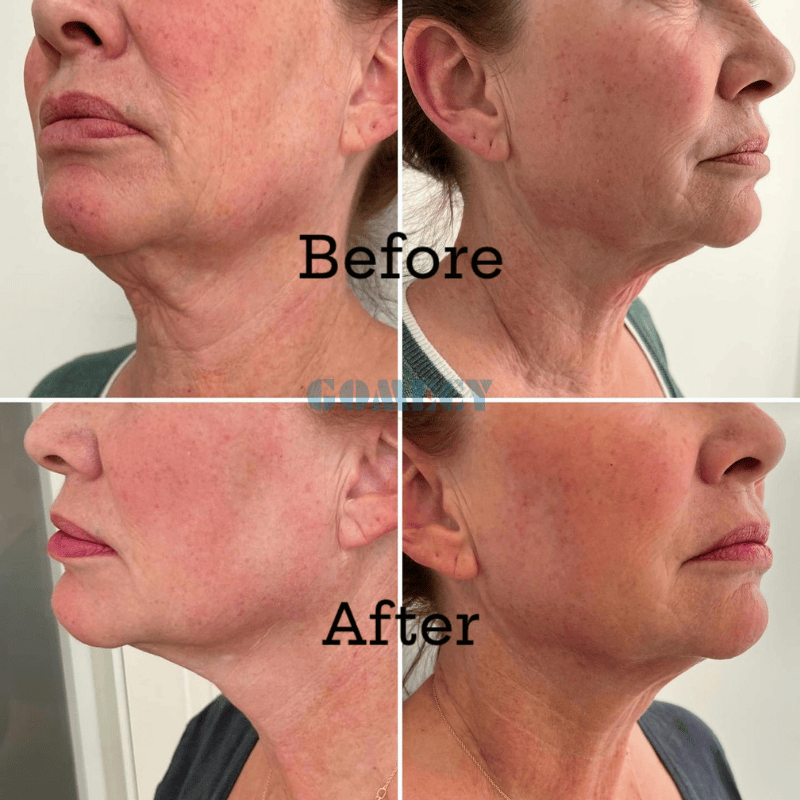
Submental (double-chin) adipose reduction and local face contouring (subdermal approach).
Localized stubborn fat pockets that are resistant to diet/exercise.
Adjunctive use in combination with manual aspiration when immediate removal of emulsified fat is required.
Note: Patient selection should follow clinical judgment and local regulatory guidance; this is a physician-operated device intended for licensed clinical settings.
High-power lipolysis laser,Dual-wavelength lipolysis device,Minimally-invasive fat reduction,Non-surgical fat melting,Targeted adipose emulsification,980nm laser lipolysis,1470nm fat reduction,Fiber-optic lipolysis handpiece,Clinical lipolysis treatment,Office-based lipolysis machine
3. Product attributes
| Item | Specification / Range |
|---|---|
| Beam transmission | Biquartz optical fiber transmission |
| Aiming (visible) beam | 650 nm (aiming) |
| Pilot beam (for targeting) | Red diode laser 635 nm, Power < 5 mW |
| Input power (AC) | 100–240 V, 50/60 Hz |
| Laser type | Diode — Pulse / CW / Single |
| Wavelengths | Dual: 980 nm + 1470 nm |
| Standard power config | 20 W @ 980 nm + 3 W @ 1470 nm (standard) |
| Optional power configs | 20 W @ 980 nm + 9 W @ 1470 nm; 30 W @ 980 nm + 9 W @ 1470 nm |
| Pulse width | 0–1.0 s (step 0.05 s) |
| Pulse duration | 0–1.0 s (step 0.05 s) |
| Typical delivery | Fiber-optic handpiece into subcutaneous fat via small incision |
| Safety notes | Built-in aiming beam; adjustable energy/pulse control (operator-set) |
(Parameters above reflect device configurations — final delivered energy, technique and accessories are decided by the treating clinician.)
High-power lipolysis laser,Dual-wavelength lipolysis device,Minimally-invasive fat reduction,Non-surgical fat melting,Targeted adipose emulsification,980nm laser lipolysis,1470nm fat reduction,Fiber-optic lipolysis handpiece,Clinical lipolysis treatment,Office-based lipolysis machine
4. Product details & clinical workflow
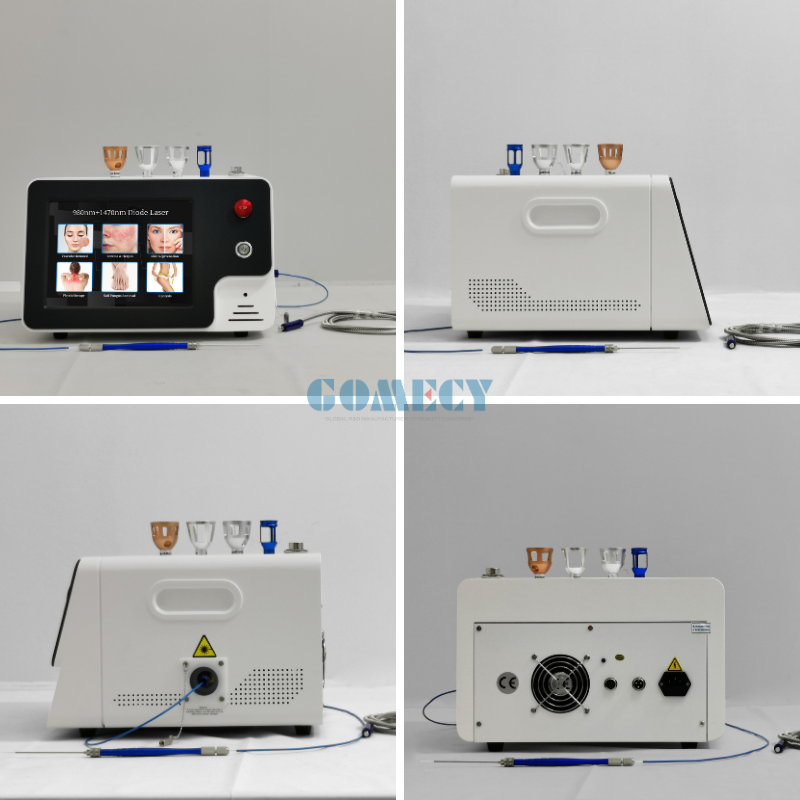
Delivery handpiece: thin, sterile optical fiber housed in a disposable or sterilizable handpiece for subdermal access. The handpiece facilitates precise placement into the fat layer through a 1–3 mm entry point.
Energy control: console provides fine control over both wavelength outputs, transition between CW/pulsed modes, and step-size adjustment for pulse width/duration to control thermal dosing.
Treatment approach (typical, high-level): tumescent infiltration is commonly used to create a safe working plane and reduce bleeding; the fiber is introduced into the treatment plane; energy is applied while the fiber is moved to cover the treatment area; emulsified fat is then aspirated or left for natural resorption based on clinical technique. Avoiding excessive dwell time at a single spot reduces risk of thermal injury.
Procedural advantages: laser lipolysis commonly provides simultaneous fat liquefaction, vessel coagulation (less bleeding/bruising), and dermal heating that encourages skin tightening — this can translate to smoother results and shorter recovery vs mechanical-only approaches.
High-power lipolysis laser,Dual-wavelength lipolysis device,Minimally-invasive fat reduction,Non-surgical fat melting,Targeted adipose emulsification,980nm laser lipolysis,1470nm fat reduction,Fiber-optic lipolysis handpiece,Clinical lipolysis treatment,Office-based lipolysis machine
5. Pre-operative & post-operative precautions
Pre-operative
Full medical history and physical exam; identify anticoagulant use, bleeding disorders, uncontrolled diabetes, active infections, pregnancy or breastfeeding — these influence candidacy. Patients on anticoagulants should be managed per their physician's guidance.
Counsel on realistic outcomes, possible bruising/swelling, and the need for compression garments.
Post-operative
Compression garment: recommended to support contouring and reduce edema; correct fit and patient instruction are important to avoid folds/irregularities.
Wound care and infection prevention: maintain incision-site hygiene; clinicians commonly prescribe short-course prophylactic antibiotics when clinically indicated — follow local protocols. Monitor for signs of infection.
Activity: avoid strenuous exercise for a period directed by the treating clinician; expect transient swelling/bruising and mild discomfort. Analgesics may be used as recommended.
High-power lipolysis laser,Dual-wavelength lipolysis device,Minimally-invasive fat reduction,Non-surgical fat melting,Targeted adipose emulsification,980nm laser lipolysis,1470nm fat reduction,Fiber-optic lipolysis handpiece,Clinical lipolysis treatment,Office-based lipolysis machine
6. Contraindications
Pregnancy and breastfeeding.
Active local infection at the treatment site or systemic infection.
Uncontrolled coagulopathy or ongoing therapeutic anticoagulation unless cleared by treating physician.
Severe cardiopulmonary disease or other systemic illnesses rendering the patient unfit for elective procedure.
Unrealistic expectations or poor skin elasticity that may limit clinical outcome (assess case-by-case).
(Practitioners must follow local clinical guidelines and perform individual risk assessments.)
High-power lipolysis laser,Dual-wavelength lipolysis device,Minimally-invasive fat reduction,Non-surgical fat melting,Targeted adipose emulsification,980nm laser lipolysis,1470nm fat reduction,Fiber-optic lipolysis handpiece,Clinical lipolysis treatment,Office-based lipolysis machine
7. Clinical outcomes & evidence summary
Laser-assisted lipolysis has been shown to liquefy adipose tissue, provide hemostasis of small vessels, and promote collagen remodeling and skin contraction when applied correctly. Outcomes depend on patient selection, technique, and energy dosing.
Wavelength selection matters: longer wavelengths in the 1400–1500 nm range have been proposed for stronger absorption by fat and water (supporting tightening), while wavelengths around 980 nm are associated with effective ablation and haemostatic properties; combined use takes advantage of both effects.
High-power lipolysis laser,Dual-wavelength lipolysis device,Minimally-invasive fat reduction,Non-surgical fat melting,Targeted adipose emulsification,980nm laser lipolysis,1470nm fat reduction,Fiber-optic lipolysis handpiece,Clinical lipolysis treatment,Office-based lipolysis machine
8. Recommended accessories & consumables
Sterile biquartz fiber disposables / sterile fiber sheath
Tumescent infiltration sets and local anesthesia supplies
Suction/aspiration cannulas and container (if immediate aspiration planned)
Compression garments and post-op dressing supplies
High-power lipolysis laser,Dual-wavelength lipolysis device,Minimally-invasive fat reduction,Non-surgical fat melting,Targeted adipose emulsification,980nm laser lipolysis,1470nm fat reduction,Fiber-optic lipolysis handpiece,Clinical lipolysis treatment,Office-based lipolysis machine
9. Ordering
Standard package: console + biquartz fiber handpiece + user manual + basic accessories (confirm with sales). Standard power: 20 W (980 nm) + 3 W (1470 nm).
Optional higher-power packages: 20 W/9 W or 30 W/9 W configurations available for practices that require higher output (select per regulatory/local practice rules).
High-power lipolysis laser,Dual-wavelength lipolysis device,Minimally-invasive fat reduction,Non-surgical fat melting,Targeted adipose emulsification,980nm laser lipolysis,1470nm fat reduction,Fiber-optic lipolysis handpiece,Clinical lipolysis treatment,Office-based lipolysis machine
High-power lipolysis laser,Dual-wavelength lipolysis device,Minimally-invasive fat reduction,Non-surgical fat melting,Targeted adipose emulsification,980nm laser lipolysis,1470nm fat reduction,Fiber-optic lipolysis handpiece,Clinical lipolysis treatment,Office-based lipolysis machine
